
The Supplemental Nutrition Assistance Program (SNAP) is a program that provides food benefits to low-income families in order to supplement their grocery budget to afford nutritious essential meals, said the US Department of Agriculture.
SNAP is known as a major stimulator of the US economy and is funded by the federal government, said Johns Hopkins Public Health Institute, and the program is administered by the states who distribute it to eligible residents.
To be eligible for SNAP, a household’s gross monthly income must be at or below 130% of the poverty line (currently $29,960 for a family of four) depending on the household size. Residents eligible receive their snap benefits of about $187 per person per month at the beginning of each month. With this, 78% of SNAP benefits are redeemed within two weeks of receiving them and 96% are spent within a month, according to Johns Hopkins Public Health Institute.
Within Oregon, 18% of our population utilizes SNAP each month, representing 12% of the total population of the US who uses SNAP. In 2023, SNAP reached the achievement of lifting 96,000 citizens of Oregon above the poverty line through its benefits. These households utilize these benefits as SNAP boosts households’ typical non-food spending, making room in family budgets to pay rent or bills or even purchase essential items such as medicine and clothing, stated by Johns Hopkins Public Health Institute.
“It’s kind of a nice safety net for families so they can use their incomes on other daily expenses,” mentioned Food Drive Leader David Ensminger.
“It provides almost like a light to a lot of Americans too, that they still can have hope for the future without worrying about something as necessary as food,” added Food Drive Leader Jason Pham.
A SNAP recipient typically runs out of their benefits before the end of the month comes. With this, SNAP recipients in Oregon begin to rely heavily on organizations such as Blanchet House to provide them with at least a meal a day as they wait for the next month to begin. As this is already a typical monthly result of SNAP recipients spending their benefits quickly, with the recent government shutdown, SNAP recipients have begun to further suffer tremendously.
“I also know a couple friends myself, who actually had to, because of their SNAP benefits, had to go into debt because they didn’t have enough money to pay for other necessities,” said Pham
The recent government shutdown resulted in also shutting down SNAP and prevented its 41 million residents nationwide from receiving their monthly benefits, said NPR’s Maria Godoy and Jennifer Ludden. With this, people have been forced to “pull back” during the holidays for meals.
“Some of the families that I have talked to, who experienced this issue first-hand, mentioned worrying about things like, do I pay my bills or do I get food?”, mentioned Associate Director of DEI Brenda Cruz.
52% of SNAP recipients mention they will use a food pantry or community food program during the holidays, along with 44% of recipients saying they’re not going to host family or friends for a holiday meal, said USA Today’s Betty Lin-Fisher.
“You’re bound to know someone in your neighborhood, or in your school impacted by this topic” added Cruz, “so it is important to be aware of how you can help or support members in your community as it relates to this issue, whether it’s by giving, just knowing more about the issue, or supporting local businesses or nonprofits that are providing food resources to anybody impacted by food insecurity, regardless of their circumstances.”
This year Jesuit’s annual food drive will be as, if not more, important than ever in order to help aid our community experiencing food insecurity during the holidays.
“This year we’ve seen a little bit of an uprise in requests for food boxes” said Ensminger
“Jesuit’s Food Drive is a really really big way [to help],” added Pham.
“This year we need it more than most” said Ensminger.
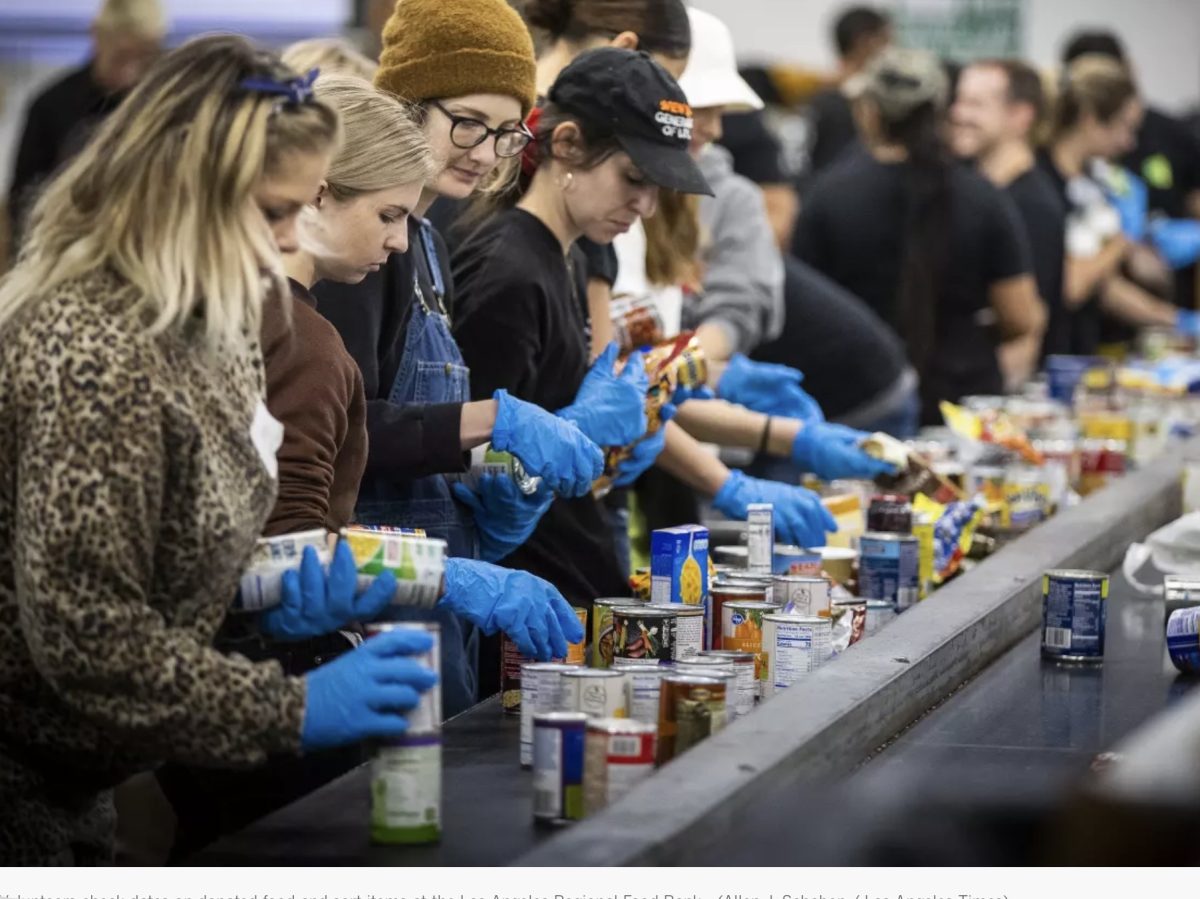
Photo creds: Volunteers check dates on donated food and sort items at the Los Angeles Regional Food Bank. (Allen J. Schaben / Los Angeles Times)